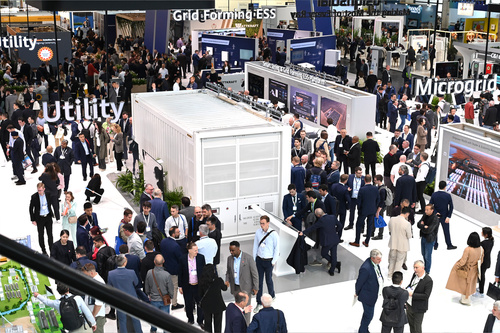
Batteries are transforming power system resilience at both utility and commercial scales, and to some extent, residential scales as well. In the session “Deep Dive: Resilient Grids with Grid-Forming Batteries: Market Opportunities and Technical Pathways” at the Battery Business & Development Forum on March 31, 2026, in Frankfurt, Germany, their growing role in grid stability, including the high potential of C&I storage systems, new inverter technologies and grid-forming batteries, was discussed.
“For many years, the residential battery market was driven by a simple value proposition: households could reduce electricity costs and increase self-consumption through battery storage. This narrative was sufficient to support residential market growth for a long time, but it is no longer enough to sustain the next phase of battery adoption, regarding grid services,” says Marie Garstecki, Regulatory & Policy Manager at sonnen Germany.
The company even has its roots in the residential storage sector and continues to aggregate thousands of private battery systems into controllable virtual power plants. These aggregated storage pools are prequalified with transmission system operators and provide Frequency Containment Reserve (FCR) services for the high-voltage grid. In this way decentralized residential batteries become a coordinated flexibility resource for grid stabilization. Despite this continued importance for flexibility, the market focus is increasingly shifting toward commercial and industrial storage solutions (C&I) as well as large-scale grid-supporting battery storage projects.
“One of the biggest challenges in renewable-heavy electricity systems is the loss of physical inertia that traditionally came from large synchronous power plants,” says Garstecki. As conventional generation is phased out, grids become more vulnerable to frequency and voltage instability. These stability risks cannot be addressed by FCR services alone. Instead, the energy system increasingly requires fast, distributed, and intelligent stabilization capabilities.
“This is one of the reasons why sonnen is expanding strongly into the C&I battery storage market – it offers new opportunities to combine existing grid infrastructure with advanced storage functionality. The underlying business logic is value stacking since battery projects are no longer economically viable based on a single revenue stream alone. Our goal is therefore to maximize the number of value streams available to distributed and mid-scale battery systems, including arbitrage, peak shaving, ancillary services, grid stabilization, and potentially grid-forming applications,” explains Garstecki.
An already existing infrastructure, faster deployment timelines, and expanding value-stacking potential make the C&I segment one of the most promising areas in the evolving storage market.
According to Carsten Wendt, Head of Large-Scale Storage at SMA Solar Technology, a large-scale energy infrastructure company, innovative inverter technologies are key to staying competitive in the area of grid-supporting large-scale BESS: “Last year, we introduced a major upgrade to our inverter platform by integrating a silicon carbide MOSFET (metal-oxide-semiconductor field-effect transistor) technology into our central inverters. As far as we know, this is the first central inverter platform using this semiconductor technology at scale, and it delivers several important advantages for large-scale storage systems.”
The upgrade increases inverter output by approximately 15 to 20 percent, enabling higher power density and reducing the number of inverter stations required per project. This lowers installation and maintenance complexity while also improving efficiency by around 1.4 percent during the charging and discharging cycle. Under German trading conditions, this efficiency gain alone can increase the net present value of a 200 MWh battery storage project by roughly €1 million.
For the German market, the most strategically important feature is the inverter’s additional thermal reserve capability. SMA’s platform allows temporary overloading above nominal power levels, which enables battery systems to provide synthetic inertia and participate in emerging grid stability markets. On top of this, SMA’s inverter can deliver an additional 35 percent temporary power boost. Combined with unused apparent power capacity, this allows participation in Germany’s momentary reserve market with approximately 775 MW-seconds of reserve capacity.
One of the key technological building blocks of future resilient power systems is grid-forming capability. “Grid-forming inverters are becoming more and more essential for maintaining power system stability as electricity grids transition toward high shares of renewable energy,” says Ivan Volodin, ESS Product Manager at Sungrow Germany. In Germany, emerging standards by the German technical-scientific association (VDE) increasingly promote the use of grid-forming inverters in applications where conventional grid-following inverter technology is no longer sufficient to maintain system stability.
Grid-forming inverters are designed to bridge this gap by combining the operational advantages of traditional grid-following inverters with the stabilizing behavior of synchronous generators. Like grid-following inverters, they offer high operational efficiency and lower maintenance requirements. At the same time, their advanced control algorithms allow them to behave as voltage sources, actively generating and stabilizing grid voltage and frequency, like synchronous generators, rather than simply following existing conditions.
In contrast to grid-following inverters, which depend entirely on an already stable external grid voltage and frequency reference, grid-forming inverters can contribute directly to grid stability, support weak grids, and maintain system operation under increasingly dynamic renewable generation conditions.
In renewable-heavy grids, sharp load variations or disturbances can quickly lead to voltage instability and electrical faults if the system cannot react fast enough. “In our simulations and field studies, grid-forming inverters respond within less than 100 milliseconds by adjusting current while keeping voltage levels stable. In contrast, conventional grid-following inverters often react by increasing voltage fluctuations, which can further destabilize the grid in the event of a fault,” explains Volodin.
“Looking ahead, grid strengthening will become one of the most important application areas for grid-forming battery systems. According to ongoing discussions around updates to German VDE requirements, future ultra-high-voltage grid connections may require mandatory use of grid-forming technologies in certain applications. For developers and operators who want to remain active in these markets, grid-forming capability will likely become a strategic requirement rather than an optional feature,” summarizes Volodin.
“The UK is currently one of the best examples to drive the greatest changes in technology and in regulations because it has managed to combine both the economic and technical aspects of grid-forming deployment in a very effective way,” says Volodin.
For example, it introduced a strong economic framework through the so-called Stability Pathfinder program. This program creates clear financial incentives for technologies that provide short-circuit strength and inertia support to the grid without relying on traditional synchronous generators. Grid-forming battery systems can participate directly in these mechanisms. At the same time, the UK also established a clear technical framework, at the first step adding the minimum technical specification for Grid Forming (GBGF) capability for converter connected technologies to the grid code (GC0137), and at the second step creating the NESO GFM guidance notes, being the practical implementation manual of the grid code.
Germany is now beginning to move in a similar direction. The country has already introduced initial inertia support remuneration mechanisms, and the main additional standards and technical requirements have been issued. Nevertheless, we still expect further regulatory developments in this area over the coming years.