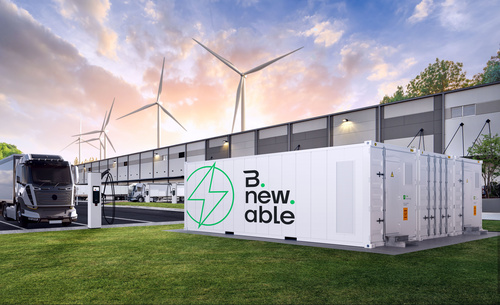
The use of battery storage in the commercial and industrial (C&I) segment is evolving rapidly. What was considered a future technology just a few years ago has now become a key component for flexibility, economic efficiency, and security of supply. In particular, behind-the-meter solutions – systems installed directly at the customer’s site – offer a wide range of opportunities to manage energy flows and generate additional revenue streams intelligently.
The company Bnewable provides insights into business models and practical applications of battery storage in C&I, with a particular focus on flexibility, multi-use strategies, and local value creation.
“As a relatively young company, we quickly realized that enabling flexibility on-site at our customers’ locations is becoming an essential infrastructure component for managing energy price volatility and grid constraints,” says Dr. Max Kronberg, Managing Director at Bnewable in Germany.
“What initially appears to be a straightforward business case – storing excess energy and using it later – often fails to generate sufficient returns when considered in isolation. In practice, standalone applications such as peak shaving or self-consumption optimization rarely justify the investment on their own. While they can provide a stable baseline, they typically leave significant value untapped.
Economic viability is only achieved when multiple value streams are combined, including peak shaving, optimizing self-consumption of on-site generation, virtual grid extension, and participation in wholesale and balancing energy markets. The key is not choosing between use cases but integrating them. This requires intelligent real-time orchestration across local energy demand, storage behavior, and market signals.”
Instead of requiring customers to fully invest in and operate battery systems on-site, Bnewable focuses on Battery-as-a-Service (BaaS) models within the C&I segment, typically ranging from 1 MW to 25 MW.
In this model, the battery system is invested in, installed, and operated by a provider who aggregates all potential value streams, both behind and in front of the meter. The revenues are used to cover investment and operational costs. This structure removes financial risk from the customer while still profiting from predictable on-site savings and additional upside from market participation.
“It’s a win-win-win situation. The customer requires no upfront CAPEX to install a battery system and benefits from various cost savings such as peak shaving or self-consumption from day one after the battery is installed. When the battery is not needed for on-site applications, which is often most of the time, we use the battery for market-based optimization and system-supporting applications, creating additional revenue streams to recover the investment. The customer then receives a share of these additional revenues, as the system is connected to their site and grid infrastructure. By doing so, we also help integrate more renewable energy while supporting grid stability and reducing system-wide price volatility,” says Dr. Kronberg.
As more large-scale storage systems are deployed, revenues from traditional front-of-the-meter applications, such as wholesale trading, tend to decline. Additional behind-the-meter value streams become more important. The first layer is offering flexibility to electricity markets and ancillary services; the next is supporting the grid locally. Increasingly, companies, such as data centers, face rejected grid connection requests due to limited capacity, while electrification demand continues to grow. In this context, batteries can provide flexibility and relieve grid constraints. Even after grid expansion, they retain value through on-site optimization.
To fully capture their potential, these value streams are combined and integrated into a single optimization framework. “This requires our own algorithm to continuously optimize charging and discharging decisions while taking local physical and economic constraints into account, such as peak load limits, local consumption optimization, and battery operating conditions. The objective is to optimize the overall cost and revenue function in real time through constant adaptation to market conditions and system constraints,” says Dr. Kronberg.