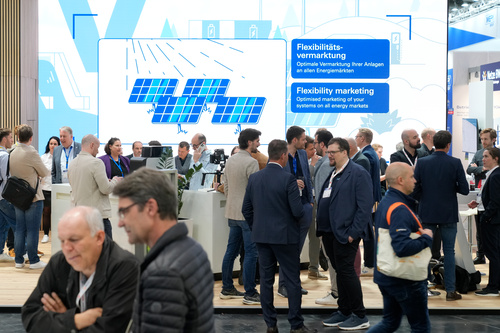
Companies can save costs and even generate additional income by flexibilizing their electricity consumption. A company's potential depends on their technical processes and how flexibly their operations can be adapted.
Service providers can help with the complex management of flexibility marketing.
How can an energy-intensive production site be both profitable and climate-friendly without incurring production risks or requiring investments into new facilities? This is the question that Ornua Foods Deutschland GmbH was trying to answer in the face of skyrocketing energy prices and tightening legal requirements. At its facility in the German state of North Rhine-Westphalia, the company packages and distributes butter, cheese and yogurt on behalf of Ornua Co-operative Limited, an Irish company. At the site, around 80,000 metric tons of Irish butter is packaged annually for the German and Austrian markets under the brand name Kerrygold.
Since 2023, Ornua has been using an AI-based energy management platform. The software balances the load in response to a dynamic electricity tariff by optimizing the operating times of compressors, cold stores and electrical steam generation for a period of 24 to 72 hours at a time, and adjusting them to requirements and market signals in real time. In the first year of operation, the software generated savings of around 9,670 euros, meaning that the investment had been paid off after just 14 months, according to Dena's Kompetenzzentrum Energieeffizienz durch Digitalisierung (competence center for energy efficiency through digitalization).
By responding to short-term price signals in spot markets, marketing operating reserves and consistently considering self-generation and electricity storage in their decision-making, companies not only benefit financially but also provide the flexibility the energy system needs.
SmartEn, the European association of the Flexible Demand Management Industry, is promoting the idea. Their mission: “To create opportunities for every company, building and car to support an increasingly renewable energy system.” According to the association, industrial companies still have a lot of untapped potential because “legacy industrial demand response programmes, such as interruptible schemes, are becoming outdated and fall short of the full value smart, market-based flexibility could deliver”.
Legacy industrial demand response programmes, such as Interruptible Schemes, are becoming outdated and fall short of the full value smart, market-based flexibility could deliver.
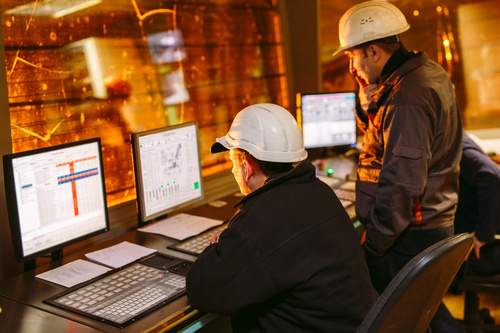
A study presented by the association in September analyzed the opportunities for flexible industrial electrification in five key sectors: iron and steel, aluminum, paper, glass and cement. The analysis clearly shows that the opportunities vary between industries: “Steel and cement units can already be operated flexibly in most cases; aluminum, paper machines and glass container units require additional investment.”
According to Entelios, a flexibility marketing company and member of SmartEn, industries “with controllable, continuous processes and a potential for creating buffers” are particularly suited for providing flexibility. These are primarily companies that can vary the time of production for energy-intensive and storable intermediate products.
Large renewable generation plants also have potential because they can participate in short-term markets, as do existing combined heat and power systems. According to Next Kraftwerke, batteries deployed at industrial locations also represent an attractive option. Installing batteries behind the meter at industrial facilities avoids grid-connection constraints, a common barrier to battery deployment. Aside from being marketed, batteries can also be used for peak shaving.
Entelios describes the limit above which marketing flexibility becomes viable. According to the company, “one megawatt (MW) has been shown to be a reasonable size for our business model involving energy-intensive industries and large flexible assets”. Given that the costs of prequalification, measurement and control technology as well as market connection are “more or less stable”, the marketing of battery storage systems becomes viable at capacities of 5 MW or more. Below that threshold, “creating a profitable business model is much more difficult – unless the capacity is bundled in pools”.
Which electricity markets trade in flexibility?
The following markets are suitable for flexibility marketing:
Spot markets: Day ahead, intraday
Balancing markets: Frequency Containment Reserve FCR, automatic Frequency Restoration Reserve aFFR, manual Frequency Restoration Reserve mFRR
Which market is interesting for whom? According to Benjamin Dausch, Head of Marketing at Entelios, this “very much depends on the asset in question”, in other words on the response time, duration of operation and availability. “Balancing markets are still attractive for flexibility options that can be controlled easily and quickly – such as battery storage –, or for specific industrial processes. This particularly applies to aFRR and mFRR.” At the same time, with the increasing volatility caused by renewable energies, intraday markets are becoming more important. FCR “continues to be interesting, but it is technically challenging and only suitable for some assets.” Creating a general ranking of markets is difficult. Benjamin Dausch says that at the end of the day, the profitability is determined by the interplay between the technical flexibility profile and the market segment.
Paul Kreutzkamp, Head of Business Development at Next Kraftwerke, considers the most attractive option to be operating reserves, which is set to change, however. “In the medium term, the earnings will approximate those of the day-ahead market, making the day-ahead market the baseline for long-term investment decisions.” The reason for this is that batteries have started entering short-term markets, and their growing supply of flexibility lowers prices. Harald Ott, Head of Demand Response at the Austrian company Verbund Energy4Business GmbH, a subsidiary of Verbund AG, agrees: “When it comes to primary balancing, we have noticed that large-scale battery storage systems have been having an effect on prices for the past six months.”
Companies need to know that they do not need their own access to the power exchange – there are service providers that can market their flexibility for them. “We offer customers access to our marketing platform where trading in the short-term energy market is managed according to the customer’s specific parameters,” says Ott.
These types of services can be financed through a revenue sharing model. In the case of Next Kraftwerke, the service providers gets 20 percent of earnings from flexibility marketing, the remaining 80 percent belong to the company.
The energy transition continues to make the electricity system more volatile, driving demand for consumer-side flexibility and opening up new business opportunities. Ornua is an example of how measurable financial effects can be achieved without major investments or fundamental changes to the production process by smart and flexible load control and by taking advantage of market mechanisms. Making processes transparent and systematically tapping into flexibility options drives down costs while strengthening resilience and asserting a company's position in an increasingly renewable energy system.