Europe is diverse, both in terms of geography and in terms of culture. And the solutions for the energy transition in the various European countries are just as diverse. The smarter E Europe regards this diversity to be an opportunity to learn from each other and to make the energy transition happen even faster and more efficient in each of the countries.
This series of articles presents innovative and successful projects from across Europe that show how a renewable 24/7 energy supply can work. The case studies should provide impulses and inspiration, turning “does not work” into “already exists”.
The floating district Schoonschip demonstrates how an energy community can bundle PV installations, battery storage systems and heat pumps to create marketable flexibility. An intelligent energy management system controls consumption and generation in real time, turning the district into an active player on the electricity and imbalance markets. The resulting revenues are impressive!
Whether it is sunny or raining, whether residents are cooking, showering or at work – an energy management system ensures that the electricity demand of the floating residential project Schoonschip in the Netherlands is met as sustainably and cost-effectively as possible. The system decides whether the electricity demand is covered by the roof-top photovoltaic installations, their battery storage systems or the power grid. The goal is to be as self-sufficient as possible.
Community energy supply
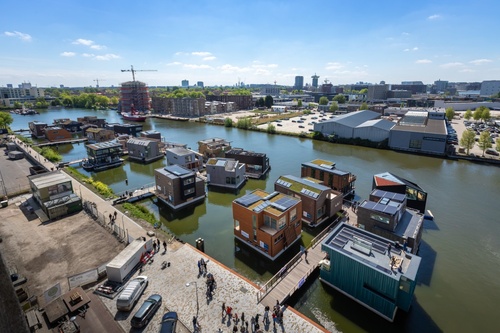
The energy community Schoonschip consists of 30 floating houses located on a side arm of the IJ canal, north of Amsterdam. The first prefabricated houses were moored in 2018, and the 46-unit district was completed in 2020. The inhabitants manage their energy supply together. The buildings have PV installations, solar thermal collectors, heat pumps and battery storage systems, which form a microgrid that is connected to the public power grid.
Amperix, the integrated energy management system used here, was developed at Fraunhofer Institute for Industrial Mathematics ITWM. Since its launch, the technology has been helping to optimize self-consumption and reduce peak load when drawing power from the grid. Every house is fitted with a control panel, which records electricity demand and production, the batteries’ state of charge and the buffer storage tank’s internal temperature. A central Amperix system monitors the three-phase grid connection and uses the decentralized control units to adjust various settings, for instance if batteries need to be charged or discharged, or if the heat pumps need to start storing excess electricity as heat. The connection point’s maximum capacity is the key factor in controlling the system, allowing the community to use as much power produced on-site as possible.
Since January 2025, the energy community has also been connected to the energy and flexibility markets, turning it into a virtual power plant that is capable of supplying and storing energy. Trading on the energy exchange is based on real-time forecasts of the energy demand of the residents and heat pumps, as well as local power generation. These data allow Fraunhofer ITWM’s control system to develop price-optimized schedules for battery storage systems, taking advantage of price fluctuations on the day-ahead market. At times when the electricity price is low, grid-supplied electricity is fed into the storage devices and fed back into the grid at a profit when prices are high. Recently, the heat pumps have also been integrated into the flexible control.
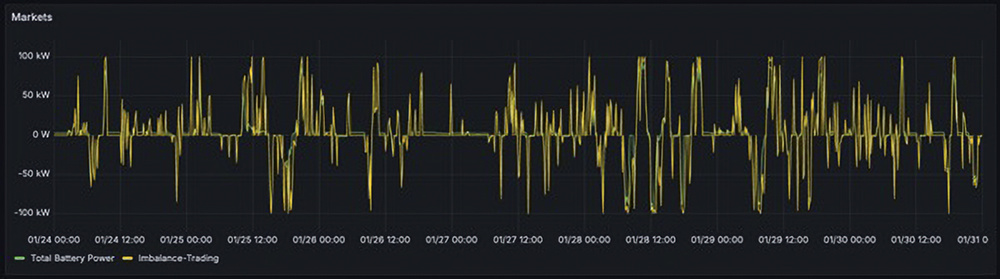
At the same time, a trader is marketing the 30 battery storage devices on the Dutch imbalance market, where prices change every 15 minutes. The storage devices can store excess electricity from the grid at short notice and feed it back in when demand is high – supporting grid stability.
The energy community can provide up to 100 kW of flexibility. And it pays off: according to Matthias Klein-Schlößl, head of the “Green by IT” team at Fraunhofer ITWM, this flexibility can generate several thousand euros per quarter for the community.
Fraunhofer ITWM considers Schoonschip to be a model for the widespread application of this technology. All private households and companies that own photovoltaic installations, battery storage systems or other flexibility options such as heat pumps or electric vehicles should have the opportunity to play an active role in energy and flexibility markets, emphasizes Klein-Schlößl.
30 Minutes to Process a Feed-in Connection Application
Zero Bills Home: Living Without Power And Heating Costs
Plug-In Solar Devices: Anyone Can Be Part of the Energy Transition