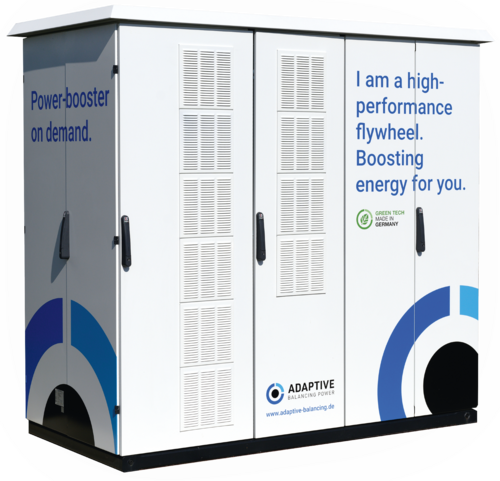
Flywheel energy storage systems are among the most promising technologies of the energy transition. They can deliver enormous amounts of power within seconds, withstand thousands of charge and discharge cycles, and excel in applications where conventional batteries reach their limits. Worldwide, only a small number of companies are commercializing systems based on levitating rotors, carbon-fiber technology, and near-frictionless energy storage. One of these players is the start-up Adaptive Balancing Power. This article explores the technology behind flywheel storage systems, their applications in industry, rail transport, and energy infrastructure, and why they could become a key building block of future energy systems.
The concept behind flywheel energy storage is not new. It is based on one of the oldest principles in physics: the ability of rotating masses to store energy. Pottery wheels and spinning tops already operate according to this principle. In theory, a rotating body would continue moving indefinitely if no friction were present. In reality, friction losses gradually slow the rotation down. For this reason, extensive research has been conducted since the 1970s, including by NASA, to minimize rotational losses. These efforts ultimately led to the modern form of flywheel energy storage systems.
Adaptive Balancing Power’s Flywheel Energy Storage System
One of the pioneering companies commercializing advanced flywheel energy storage systems is Adaptive Balancing Power. The company’s founders, Hendrik Bodenschatz and Nicolai Meder, initially conducted research on high-performance permanent magnets at the Technical University of Darmstadt in Germany. Their work led to the idea of suspending rotating masses with almost no friction and using them as energy storage systems. The company was spun out of the university in 2016.
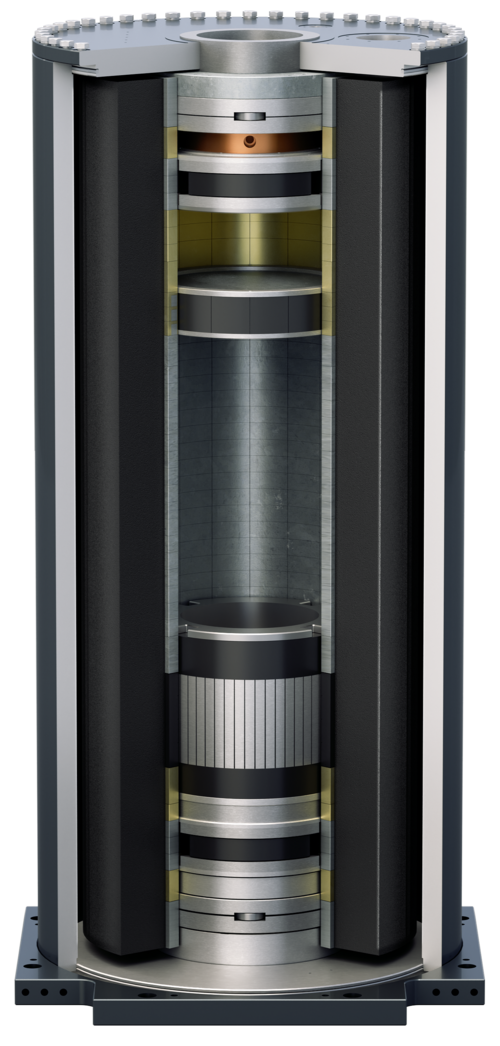
The so-called second generation of flywheel energy storage systems – the technology integrated into Adaptive Balancing Power’s solution – is based on a freely levitating rotating unit. The rotor, weighing around 850 kilograms, spins contact-free around a stationary core inside a vacuum chamber at speeds of up to 18,000 revolutions per minute. This is made possible through the use of permanent magnets, which keep the system stably suspended while significantly reducing mechanical losses.
The operating principle is based on the concept of an electrical machine. An electric motor generates rotational movement through a magnetic field and accelerates a freely suspended, contactless flywheel mass inside a vacuum. The vacuum environment enables extremely high rotational speeds while minimizing friction losses.
During the discharge process, the principle is reversed: the rotating mass drives the motor as a generator, converting kinetic energy back into electrical energy. The motor and flywheel therefore form a symbiotic system for energy absorption and energy release. Depending on the configuration, multiple motors can be integrated to provide higher output levels. Typical system capacities range between 125 kilowatts and 500 kilowatts per unit.
Unlike conventional battery storage systems, flywheel energy storage does not store energy chemically. Instead, the system operates entirely mechanically. Electrical energy is converted directly into rotational energy and, when required, transformed back into electricity. This direct energy conversion takes place without electrochemical processes, without performance degradation caused by repeated cycling, and largely independent of temperature fluctuations.
One of the key advantages of flywheel technology lies in its exceptionally high cycle stability and power density. While conventional battery systems are designed for long-term energy storage and typically withstand only several thousand charge and discharge cycles, flywheel systems are optimized for rapid charging and discharging without significant loss of performance over time. Since there are no conventional chemical degradation mechanisms, the lifespan of the system is determined primarily by the mechanical integrity of its materials. The core components consist mainly of metal, copper, and carbon fiber. The two technologies therefore serve different purposes within an energy system. In practice, this creates not a competitive relationship, but a complementary one: the weaknesses of one technology are offset by the strengths of the other.
Which Industries Benefit from the Technology?
One important application area is industrial peak shaving. In production areas such as robotics facilities, injection molding plants, or manufacturing lines, operational processes regularly create short-term power peaks. Flywheel storage systems compensate for these fluctuations, relieve stress on the grid, and reduce grid-related energy costs at the same time.
Hospitals represent another particularly demanding environment. Power, heating, and in some cases emergency electricity supply must remain available at all times. These systems can be supported through district heating, gas-fired power plants, diesel backup generators, or modern technologies such as fuel cells. Within these infrastructures, flywheel energy storage systems play a central supporting role. They provide immediate power, stabilize the system during critical moments, and bridge blackout scenarios while backup power sources are starting up. Typical operating times range from just a few milliseconds up to around 15 minutes.
Another key application is grid stabilization. As renewable energy generation continues to expand across Europe, flywheel storage systems are increasingly deployed in clusters to support electricity networks. In these applications, they help maintain frequency and voltage stability within the grid. At this scale, modular systems operating in the multi-megawatt range are used.
A third major application area is rail transport. In this sector, regenerative braking energy produced when trains slow down is captured by the flywheel storage system and reused to accelerate other trains when needed. The primary objective is not only energy savings, but above all the stabilization of the railway power network. This allows more trains to operate on the same line while maintaining a constant voltage level. Especially in heavily used urban rail systems such as metro networks, this creates significant infrastructure advantages, as the expansion of additional overhead lines or substations can partially be avoided. Such systems are currently being implemented in concrete railway projects and are in the final stages of planning and installation.
Against the backdrop of these diverse application areas, Adaptive Balancing Power positions itself as a growth-oriented industrial start-up. Alongside its activities in Europe, from Southern Europe to the Nordic countries, the company is focusing on building an international partner network extending into the Middle East in order to bring the technology into additional markets.