Packed halls, a vibrant atmosphere and a buzzing vibe – after three days, The smarter E Europe 2026, Europe’s largest alliance of exhibitions for the energy industry, has come to a successful close. The event held at Messe München offered a glimpse of a future-oriented energy world powered by renewables. A strong signal with a clear message went out to the world from the Bavarian capital: The future is renewable. Renewable energies can help ensure a reliable, secure and cost-effective energy supply around the clock, seven days a week. A total of 2,650 exhibitors from 52 countries – many of whom had expanded their booth space compared with the previous year – demonstrated how this can work. More than 66 percent of exhibitors were from outside of Germany. They presented innovative and market-ready products ranging from virtual power plants, smart grid and load control, smart charging solutions, storage technologies and PV hybrid systems to digital platforms that manage energy flows transparently and flexibly. The technical program began one day before the exhibition opened, on June 22 and 23, 2026, with four specialist conferences as part of The smarter E Europe. Including the side events, more than 3,000 participants gathered for an intensive exchange of knowledge and discussions on the latest industry developments. At the exhibition grounds, approximately 105,000 trade visitors from 163 countries took the opportunity to learn about new trends across industries and sectors, to network and to gain insight into the energy system of tomorrow.
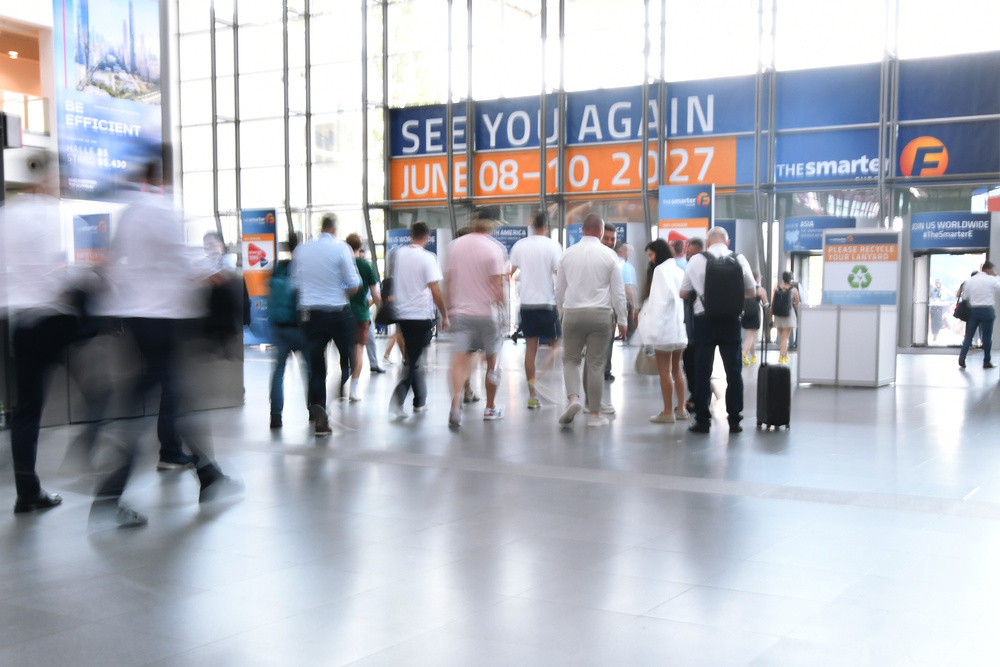
The path forward is clear; the technologies, solutions and business models are already in place. This was illustrated at The smarter E Europe, which brings together the four exhibitions Intersolar Europe, ees Europe, Power2Drive Europe and EM-Power Europe, as well as accompanying conferences and side events. The industry projected confidence and a spirit of innovation. Across all 19 exhibition halls and the Outdoor Area, there was a palpable sense of enthusiasm for contributing to major societal change and advancing the energy transition. Globally, the expansion of renewable energy is proceeding at a rapid pace. “We are in the midst of a global transformation toward a completely new energy system. We cannot stop this revolution and must seize all the opportunities that exhibitors have shown us," says energy expert and author Dr. Tim Meyer.
He also led a tour of the special exhibit Renewables 24/7 – Secure Energy for a Changing World, which was among the exhibition’s highlights. It demonstrated that the energy system of the future can be fundamentally different from what we have today: more electric, more decentralized, more digital and more flexible. Tomorrow’s energy will no longer come from a handful of power plants but from millions of interconnected systems. Visitors were able to experience firsthand how solar and wind power are lowering electricity costs and how buildings and electric vehicles are transforming from mere consumers into active participants in the energy system. “The smarter E Europe and the special exhibit Renewables 24/7 showed that the energy transition needs one thing above all else: flexibility. Only if we store and manage electricity intelligently and use it precisely when it is particularly affordable and green, can we create an energy system that is affordable for customers and still good for the grid," explains Bastian Gierull, CEO of Octopus Energy Germany GmbH. “At the same time, it highlighted the important role of electric vehicles – and, looking ahead, bidirectional charging – as flexible storage solutions in a renewable energy system.”
Even today, electricity can be generated much more cheaply from renewable sources than from fossil fuels. In Germany alone, about 60 percent of electricity is generated from renewable sources. The country spends 80 billion euros a year on fossil fuel imports. Recent geopolitical crises, however, have shown that fossil fuel imports can foster dependencies, make countries vulnerable to coercion and burden economies and societies with high energy costs. “Fossil fuels are a thing of the past; the future clearly belongs to renewables. Over the three days of the exhibition, we demonstrated through practical examples and scientific evidence that renewables provide reliability, resilience and efficiency while making economic sense. That is why the path toward a renewable future must be pursued consistently. There can be no turning back,” explains Markus Elsässer, founder and CEO of Solar Promotion GmbH. “This year, with our focus on Renewables 24/7, we addressed the right topic at the right time. We have shown that we are thinking ahead and helping shape the future,” says Jens Mohrmann, Managing Director of Freiburg Wirtschaft Touristik und Messe GmbH & Co. KG (FWTM).
Europe’s largest alliance of exhibitions for the energy industry demonstrated the opportunities that renewable energies offer to the economy and society by helping to limit the damage caused by the climate crisis and significantly reducing energy costs for businesses and consumers. Nevertheless, concerns and misconceptions about the “dark doldrums” continue to circulate. A panel discussion addressed the question of whether the energy transition is failing only in perception. The panel’s unanimous conclusion was that the energy transition has long been accepted and supported by large segments of society, with barriers to it, or even its failure, existing only in the minds of a small number of political and economic decision-makers.
The significance of the exhibition alliance was also reflected in the large number of politicians at the event. Rita Schwarzelühr-Sutter, Parliamentary State Secretary at the Federal Ministry for the Environment, Climate Action, Nature Conservation and Nuclear Safety (BMUKN), delivered opening remarks before the panel discussion. She made it unequivocally clear that in Germany, the issue is no longer “only” about climate protection but also about some 440,000 jobs, economic growth, resilience and national security. Bavarian State Minister Hubert Aiwanger also attended to engage in technical discussions and open the Hydrogen Dialogue Summit, which took place for the first time in 2026 as part of The smarter E Europe. In addition, Barbie Haller of the German Federal Network Agency was among the event’s high-profile guests.