For the major economies, the transformation towards a climate-neutral industry is one of the central tasks for the coming decades. While the European Union has pledged climate neutrality by 2050, China’s goal is to be climate-neutral by 2060. In both regions, hydrogen is a key to transforming their manufacturing and energy industry. However, the actual market development is lagging behind these ambitious objectives: According to the Global Energy Report 2025, only 11 percent of hydrogen projects announced since the start of the decade are now in operation or have been secured by investment decisions. This is why ees Europe, Europe’s largest and most international exhibition for batteries and energy storage systems, is putting a spotlight on hydrogen. The newly aligned exhibition segment Hydrogen Dialogue Forum & Expo in hall B2 will be giving in-depth information about the opportunities for hydrogen technology, technological innovation, savings potential and ground-breaking projects from June 23–25. The exhibition will be complemented by the accompanying Hydrogen Dialogue Summit taking place at ICM – Internationales Congress Center München on June 24 and 25. ees Europe is one of four exhibitions held as part of The smarter E Europe. Around 2,800 exhibitors and over 100,000 trade visitors are expected to attend Europe’s largest alliance of exhibitions for the energy industry.
While the global demand for hydrogen continues to rise, production is currently predominantly based on fossil fuels, such as natural gas or coal. Hydrogen is traditionally used for ammonia production, oil refining and methanol synthesis. So far, the share of carbon-neutral hydrogen is negligible. But emission-free hydrogen is considered an indispensable component of the energy transition, particularly when it comes to decarbonizing sectors such as the steel industry, which are difficult to electrify. Despite the great demand, economic, regulatory and infrastructure hurdles are slowing down its deployment. Along with the cost structure, the expansion of pipelines and the repurposing of existing natural gas infrastructure remain a main bottleneck. According to analyses by the International Energy Agency (IEA), green hydrogen still costs two to three times as much to produce than the fossil-based variant. If the price of natural gas becomes unpredictable, or remains high, conventional production will lose its price advantage though, making the sustainable alternative competitive.
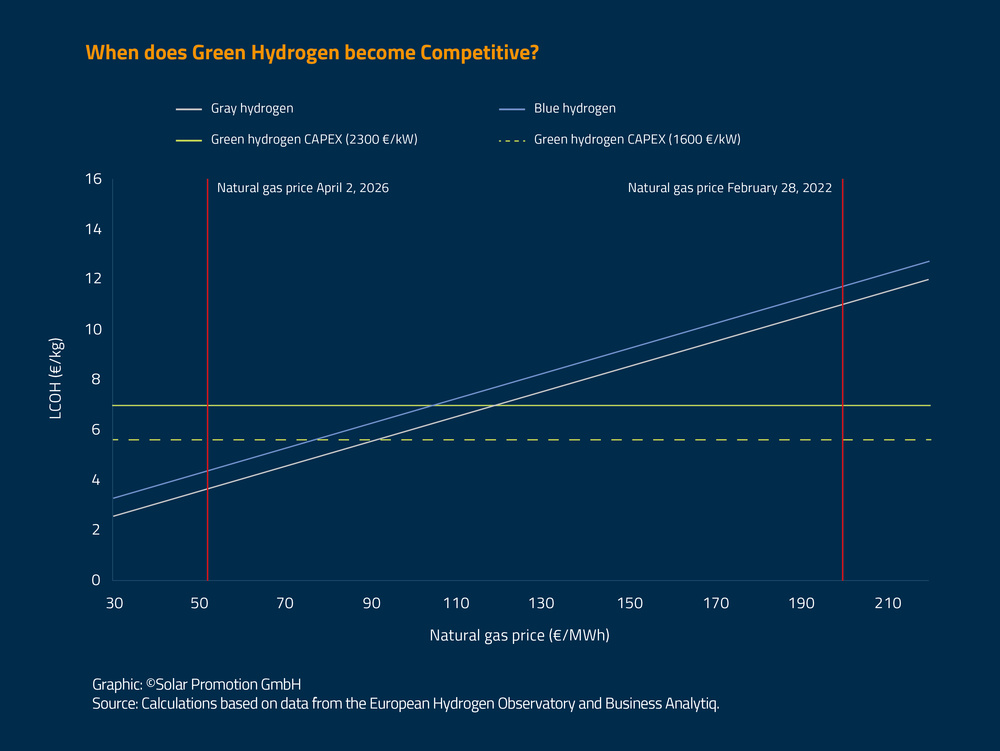
According to the Global Energy Report 2025, around 100 million metric tons of hydrogen were produced in 2024. Around 99 percent came from fossil fuels, emitting around 980 million metric tons of CO2. Less than one percent were produced without emissions. Electrolysis enables the climate-neutral production of hydrogen, if water is split into hydrogen and oxygen using renewable electricity. The IEA is expecting considerable growth in the coming years, with green hydrogen production rising to 4.2 million metric tons globally by 2030. This would be a five-fold increase compared with 2024. The driving force behind the deployment of electrolyzers is China. The IEA expects emission-free hydrogen to be competitive in China by the end of the decade. Low technology and cost of capital will drive this development. According to the IEA, the prospects for green hydrogen in Europe are also promising because carbon pricing is driving up the price of natural gas. Regions with access to cheaper natural gas, such as the United States and the Middle East, have less potential.
The ongoing energy crisis is driving home the consequences of fossil dependency. The war in Iran has led to a surge in the price of crude oil and natural gas, and many countries are hit hard by this. The outbreak of the Russian invasion of Ukraine also led to a sharp increase of natural gas prices. At that time, green hydrogen was actually considerably cheaper than conventional hydrogen. “The repeated price shocks and supply risks that are inherent to the fossil energy industry are raising awareness of the strategic value of renewables and green hydrogen,” says Markus Elsässer, founder and CEO of Solar Promotion GmbH. “A future-proof energy system depends on more than the production of clean electricity. We also have to ensure its intelligent storage and cross-sector availability. Only by flexibly coupling decentralized generation, modern battery storage and hydrogen electrolysis can we ensure a secure energy supply for industry. Green hydrogen is a key lever to make Germany’s and Europe’s energy supply resilient and technologically independent with stable electricity prices.”
Green hydrogen is an essential element of decarbonization. The industry desperately needs this energy carrier for steel production, high-temperature processes exceeding 1,000 Celsius and the production of synthetic fuels for heavy goods, sea and air transport. In district heating networks, green hydrogen could replace natural gas. So far, however, there are not enough electrolyzers to implement this. While the European Union is striving for 40 gigawatts of domestic electrolyzer capacity by 2030, and with countries like Germany, Spain and France setting ambitious national goals, practical implementation is lagging behind policy ambitions. Progress is slow because of the lack of infrastructure and the lack of demand, making potential investors hesitant. The production of synthetic fuels could be a way of driving demand. “The role of hydrogen as an energy carrier of the future is still not fully recognized. The Hydrogen Dialogue covers the entire value chain and is designed to set a clear signal in favor of ramping up production,” says Jens Mohrmann, Managing Director of Freiburg Wirtschaft Touristik und Messe GmbH & Co. KG (FWTM).
Industry needs viable solutions. In response to this need, the Hydrogen Dialogue Summit at The smarter E Europe will be shedding light on the hydrogen industry’s current trends and challenges. On June 24, the spotlight will be on Germany. Key topics will be the contribution of electrolysis to cushioning grid congestion, making better use of renewable sources of energy, and how the chemical, cement and steel industries can turn decarbonization into a competitive edge. On June 25, all eyes will turn to Europe and the wider world, as well as the rise of Asian competition. On both days, policymakers and industry leaders will be discussing the strategic importance of hydrogen for a future resilient and climate-friendly energy supply with German and European decision makers from industry and associations. The Hydrogen Dialogue Summit is sponsored by Bavarian Minister of State for Economic Affairs, Regional Development and Energy, Hubert Aiwanger, who will be opening the event.