The German battery energy storage market is growing rapidly. According to the German Solar Association (Bundesverband Solarwirtschaft e.V., BSW-Solar), newly installed storage capacity increased by 91 percent to approximately 8.2 gigawatt-hours (GWh) in the first nine months of 2026 compared with the same period in the previous year.
Alongside this strong market growth, the economic conditions for battery energy storage systems (BESS) are also evolving. Falling battery prices are improving investment conditions, while widening electricity price spreads are creating additional revenue opportunities in energy trading. At the same time, the growing installed base of battery storage systems is intensifying competition for attractive revenue opportunities.
Utility-scale battery storage systems are the main growth driver of the German battery storage market in 2026. From January through September 2026, approximately 3.8 gigawatt-hours (GWh) of new utility-scale storage capacity were installed. This segment therefore accounted for roughly half of the total 8.2 GWh in newly installed battery storage capacity. Compared with the same period in the previous year, this represents growth of approximately 350 percent. These figures are based on an analysis by BSW-Solar using data from the Federal Network Agency's Market Master Data Register (data as of October 2026). This trend is also expected to continue across Europe. In its medium scenario in the European Battery Market Outlook 2026–2030 , published in June 2026, SolarPower Europe forecasts that cumulative installed utility-scale battery storage capacity will reach approximately 392 GWh by 2030. This would account for around 67 percent of Europe's total installed battery storage capacity.
There is also good news for electrical contractors and installers: Germany's commercial and industrial (C&I) battery storage market is experiencing significant growth. According to BSW-Solar, approximately 0.7 GWh of new capacity was installed between January and September 2026, representing a 67 percent increase compared with the same period in the previous year. Across Europe, SolarPower Europe expects cumulative C&I storage capacity to reach approximately 68.7 GWh by 2030. This would represent around 12 percent of Europe's total installed battery storage capacity.
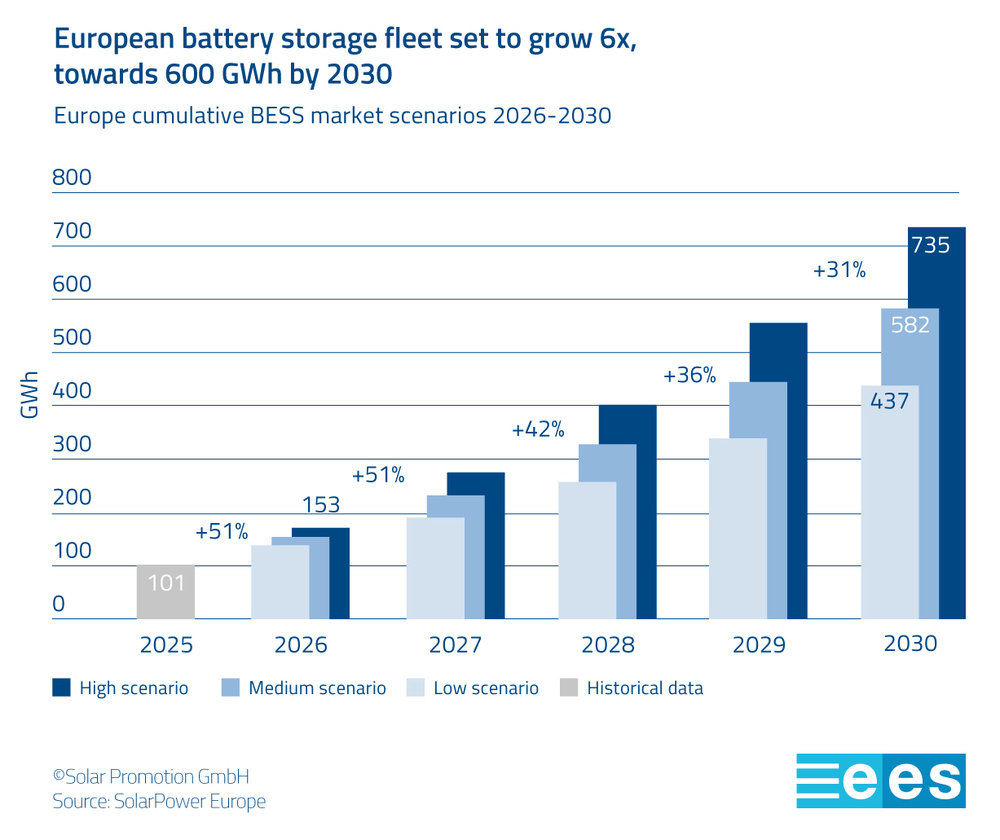
Residential battery storage systems will also continue to represent an important business segment for installation companies. According to BSW-Solar, approximately 3.2 GWh of new residential storage capacity was added in Germany between January and September 2026. This corresponds to roughly half a million battery storage systems installed in just nine months and represents growth of 20 percent compared with the same period in the previous year. For the European residential battery storage market, SolarPower Europe forecasts that cumulative installed capacity will increase to approximately 121 GWh by 2030 under its medium scenario. Residential storage systems will therefore remain an important market segment, even though their share of total installed storage capacity is expected to decline to 21 percent, partly due to the particularly rapid expansion of utility-scale battery storage.
As the utility-scale battery storage market expands rapidly, the underlying economic conditions are also changing. As increasing numbers of battery storage systems purchase electricity when prices are low and feed it back into the grid when prices are higher, the available price spreads – the differences between charging and discharging prices – may narrow. This, in turn, could reduce the revenues achievable through energy arbitrage. The Institute of Energy Economics at the University of Cologne (Energiewirtschaftliches Institut an der Universität zu Köln, EWI) describes this potential cannibalization effect in an analysis published in April 2026 on the use of utility-scale battery storage systems in the German electricity system . However, the extent to which this effect will actually materialize remains uncertain.
Competitive pressure is also increasing in the provision of balancing capacity. Transmission system operators (TSOs) use balancing services to compensate for fluctuations between electricity generation and consumption and to maintain grid frequency at a stable 50 hertz. Battery storage systems can respond at short notice by absorbing electricity from or injecting electricity into the grid. If the supply of available balancing capacity grows faster than demand, the revenues that operators can earn from these services may also decline.
However, the outlook varies across individual markets. While EWI expects increasing market saturation and declining revenues, particularly in the balancing reserve markets, revenue opportunities in electricity trading could remain comparatively stable. Flexible market participation strategies are therefore becoming increasingly important for battery storage operators and project developers.
So-called cross-market optimization involves assessing revenue opportunities across different markets simultaneously and allocating available storage capacity to different revenue streams according to prevailing market conditions. For example, battery storage systems can combine electricity trading on the day-ahead and intraday markets with the provision of balancing capacity and the associated revenues from balancing energy.
Additional revenue opportunities may also arise from providing ancillary services. One example is the provision of reactive power for voltage regulation in the electricity grid. The capacity market could offer another potential source of revenue. Unlike conventional electricity markets, where payment is based on the actual volume of electricity traded, capacity markets remunerate the availability of firm electrical capacity. The German Electricity Supply Security and Capacity Act (Strom-Versorgungssicherheits- und Kapazitätengesetz, StromVKG) , which entered into force in July 2026, establishes the regulatory framework for introducing this market in Germany. The first tenders are already scheduled to take place in 2026, while the first delivery period for the contracted capacity is set to begin on November 1, 2031.
For commercial and industrial (C&I) battery storage systems, the primary objective is often to optimize operating energy costs. Through peak shaving, businesses can reduce peak demand and thereby lower demand-based electricity grid charges. When combined with photovoltaic (PV) systems, excess solar electricity can be stored and used on-site at a later time. Additional opportunities include flexible electricity procurement and the integration of battery storage systems into the charging infrastructure for electric vehicle fleets. The joint guide Stromspeicher in Industrie und Gewerbe [Electricity Storage in Industry and Commerce] , published by the Energy Storage Systems Association (BVES) and the Association of German Chambers of Commerce and Industry (DIHK) in March 2025, uses practical examples to demonstrate how these applications can be combined.
Looking ahead, LCP Delta and Energy Storage Europe expect further growth in the C&I storage market, driven in particular by the increasing electrification of commercial and industrial operations, according to their European Market Monitor on Energy Storage , published in July 2026. Declining technology costs and the growing availability of flexibility and grid stability services could further improve the economic viability of battery storage systems. At the same time, grid charges remain a significant cost factor for commercial and industrial electricity consumers.
Residential battery storage systems have primarily been used to store self-generated solar electricity for later consumption within the household. However, their potential for market-price-driven operation remains largely untapped. This is highlighted by the German Institute for Economic Research (DIW Berlin) in its Energiewendemonitor [Energy Transition Monitor 2026] . Among the reasons cited are fixed feed-in tariffs for PV systems and delays in the rollout of smart metering systems.
Dynamic electricity tariffs could open up additional applications. Since January 2025, electricity suppliers in Germany have been required to offer dynamic tariffs to all customers equipped with smart metering systems. When combined with PV systems, heat pumps, and electric vehicles, battery storage systems can, for example, be strategically charged when electricity prices are low, while the use of stored electricity can be optimized to match periods of higher prices.
As the market expands, grid connection requirements and the integration of battery storage systems into the electricity grid are becoming increasingly important alongside revenue opportunities. In an analysis published in February 2026 on the efficient integration of utility-scale battery storage systems , the German Energy Agency (dena) points out that, despite their flexibility, battery storage systems can also exacerbate existing grid constraints or even cause short-term congestion if their operating strategies are not sufficiently aligned with local grid conditions. Flexible grid connection agreements can enable storage projects to connect even where grid capacity is limited. Dynamic, location-specific price signals are also intended to create incentives for more grid-supportive operation. Going forward, both instruments could influence where storage projects are developed and how they are operated.
The German Solar Association (BSW-Solar) also sees a need to adapt existing grid connection requirements. In its policy paper published in October 2026, the association calls, among other things, for a legally binding nationwide right to fair and flexible grid connection agreements. These agreements are intended to facilitate both the grid connection and economically viable operation of battery storage systems, particularly when combined with PV and wind power plants or installed at sites with significant electricity demand.
In addition, BSW-Solar advocates mandatory competitive tenders for grid-supportive battery storage systems at substations and changes to redispatch control at the grid interconnection point. These measures could help make more efficient use of existing grid capacity and allow surplus renewable electricity to be stored during temporary grid constraints. A study by the Fraunhofer Institute for Energy Economics and Energy System Technology (Fraunhofer IEE) demonstrates the additional PV potential that could be unlocked through such storage systems. In this article , ees Europe reports on the study's findings and the potential to enable an additional 150 GW of installed PV capacity.
For project developers, operators, and investors, the economic viability of battery storage projects increasingly depends on how well the project location, available grid connection capacity, and storage system sizing are coordinated. One way to make more efficient use of existing grid capacity is through co-location, which involves operating a battery storage system alongside a PV or wind power plant at the same grid interconnection point.
In an interview with ees Europe , Claus Urbanke, VP Wind, Solar and Storage Development, and Klaas Bauermann, Head of New Business at Statkraft Germany, explain how combining PV generation with battery storage can enable hybrid power purchase agreements (PPAs), allowing solar electricity to be delivered with greater temporal flexibility. They also discuss the importance of storage system sizing, project location, and available grid connection capacity in determining the optimal marketing strategy and economic success of utility-scale battery storage projects.
The battery storage market is thus evolving from a rapidly growing technology market into an increasingly competitive component of the energy system. Consequently, the continued expansion of installed capacity alone will not determine the pace of future market growth. Instead, successful storage projects will need to combine economically viable revenue strategies with suitable locations and operating strategies that support the overall electricity system as effectively as possible.