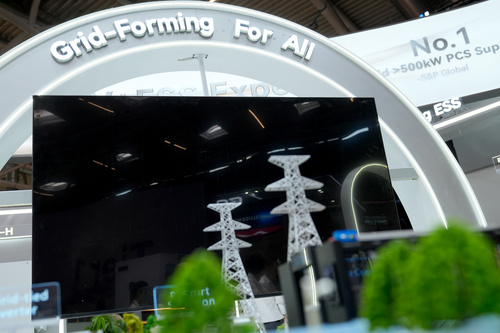
Grid-forming inverters are becoming a core capability of renewable power plants. In this interview, Elisa Blasco Muñoz, Product & Applications Team Leader IEC at Power Electronics, explains the technology behind grid-forming storage inverters, why overload capability is the toughest challenge, how grid codes from Australia to Chile are shaping product development and why a new direct current-to-direct current (DC-DC) converter configuration could matter for tomorrow’s data centers. The interview was recorded at The smarter E Europe 2026.
We continuously monitor the market and the grid codes emerging worldwide. When we recognized the grid-forming trend years ago, we began the corresponding software development and hardware testing, and today both of our storage inverters can operate in grid-forming mode.
In grid-following mode, the inverter controls current; in grid-forming mode, it controls voltage and frequency at its terminals, injecting more or less current to help stabilize the grid. This lets plants support weak grids affected by outages, voltage dips or frequency variations, and mimic the inertial behavior we’re losing as synchronous fossil-fuel plants are phased out. Beyond black start, starting a plant from zero, the toughest requirement is overload capability: during a voltage dip, the inverter must briefly supply more than its nominal current to help the grid recover.
That’s where we’ve focused recently. Moving to more powerful, higher-quality semiconductors, we raised our maximum power from 4.39 to 5.36 megawatts (MW) and increased overload capability. Grid codes are driving this: Australia and the United Kingdom (UK) are the most mature, Germany published its VDE FNN guideline last year, and Chile now requires plants to operate at 130% for five seconds.
We aim for a single product that complies with all grid codes. We offer two inverter types, but the inverter core and the software are identical in both. Whenever a country updates its grid code, as Chile did this January, my team reviews the new requirements and checks whether our current inverter already complies. If not, we develop what’s needed. It’s an ongoing process.
Cybersecurity requirements are being tightened significantly. Certification will become mandatory, in Europe through the Cyber Resilience Act (CRA), and via a standard from the International Electrotechnical Commission (IEC), specifically, IEC 62443. Inverter manufacturers will need to be certified, and we’re already building a cybersecurity layer into our software so we’re ready when the requirements take effect. Like grid forming, it’s starting gradually, but it will apply to all manufacturers wanting to sell in Europe and beyond.
Not yet. We haven’t seen the demand for it. Grid-forming capability exists to support the grid whenever something happens, which means all the time, not only when the sun is shining. That’s why the requirements focus on storage plants. We don’t want separate software for different projects, so we maintain one software package and keep adding requirements to it. Grid forming can simply be enabled or disabled: the capability is always there, and the software is the same across all projects.
Today it makes no difference. Previously, running an inverter in grid-forming mode required a better inductor-capacitor (LC) filter with a different inductance, so we had to change the filter, and that added cost. We sometimes had projects installed without those requirements, and years later, once their country introduced grid-forming rules, the customer would ask whether the inverter could run in grid-forming mode. Then our service team had to go out and replace the filter, which made little sense. Now all our storage inverters ship ready for grid forming in both hardware and software, so the price is the same and the capability is there if a customer wants to enable it later.
Australia, by far - they were among the first to document and require grid-forming inverters. Planning a project there involves a very detailed, rigorous study process before the plant is even built: you model the inverters, cables and transformers in software and simulate the different scenarios that can occur in the plant. The Australian Energy Market Operator (AEMO), the grid operator, then has to approve your plans, followed by further testing. Because Australia was one of the first countries to define these requirements in writing, we’ve learned a great deal there. Many countries have since mirrored the Australian approach - much of Chile’s grid code, for instance, is essentially copied from AEMO. For us, Australia is the most important market for grid forming, because that’s where we started.
Not really. The first countries with these requirements - Australia and the UK - are islands, so they lack the interconnected grid structure we have in Europe. But the requirements themselves are very similar.
Traditionally, a DC-coupled plant used a solar inverter connected to the photovoltaic (PV) array, with a DC-DC converter and batteries on the inverter’s DC bus. You could store excess PV power in the battery or charge it from the grid where permitted. But the solar inverter can’t provide advanced grid support, and delivering grid-forming functionality from the battery meant going through two stages: inverter plus DC-DC converter. Grid forming requires a very fast plant response, and that arrangement couldn’t meet it.
So we reversed the setup. Instead of a solar inverter, we connect a storage inverter to the battery, so the grid-forming functionality sits in the storage inverter, with a single stage managing the fast response, and because it runs off the battery, it’s available at all times, independent of the sun. On the storage inverter’s DC bus we then place the DC-DC converter connected to the PV array, adding a maximum power point tracking (MPPT) algorithm so it works with the PV plant. This keeps the advantage of DC coupling - no extra transformer needed - while providing grid-forming capability as a standalone base plant. We already have projects planned with this configuration, and we expect it to be more successful than the previous approach.
Correct.
Yes, we have several projects in development, though the plants aren’t built yet.
Yes, particularly the DC-DC converters. In the future, data centers will be supplied with DC rather than alternating current (AC) as they are today, so a solution that sits between the data center and the batteries becomes very important. We think the DC-DC converter will play a significant role in these new, DC-supplied data centers.